SAP FICO Course Syllabus for Beginners – A Complete Guide to Launch Your Finance Career
In today’s fast-changing job market, combining finance knowledge with technical skills can give you a major career advantage. One of the best ways to achieve this is by learning SAP FICO. It is one of the most widely used modules in SAP and plays a crucial role in managing financial operations in organizations.
Understanding SAP FICO
SAP FICO is made up of two important components:
Financial Accounting (FI): Focuses on external financial processes like balance sheets, profit and loss statements, and legal reporting
Controlling (CO): Deals with internal business reporting such as cost control, budgeting, and performance analysis
SAP FICO Course Syllabus – What You Will Learn
A beginner-level SAP FICO course is designed to cover both theoretical concepts and practical implementation. Let’s look at the main modules included in the syllabus.
1. Introduction to ERP and SAP
Before learning FICO, you will start with the basics of ERP systems:
What ERP is and why it is used
Overview of SAP and its importance in businesses
Understanding different SAP modules
Basics of SAP navigation and interface
2. Financial Accounting (FI) Module
The FI module is the core of SAP FICO and focuses on financial transactions and reporting.
General Ledger (GL)
Setting up chart of accounts
Recording journal entries
Managing financial documents
Preparing financial reports
Accounts Payable (AP)
Vendor master data creation
Processing supplier invoices
Managing outgoing payments
Accounts Receivable (AR)
Customer account setup
Billing and invoicing
Tracking incoming payments
Asset Accounting (AA)
Handling fixed assets
Calculating depreciation
Managing asset lifecycle
Bank Accounting
Maintaining bank data
Processing bank transactions
Performing bank reconciliation
3. Controlling (CO) Module
The CO module focuses on internal financial management and cost tracking
Cost Element Accounting
Understanding cost classifications
Cost allocation techniques
Cost Center Accounting
Creating cost centers
Monitoring departmental expenses
Profit Center Accounting
Evaluating profit performance
Analyzing revenue and costs
Internal Orders
Managing specific projects or activities
Tracking associated costs
4. Integration Between FI and CO
One of the key strengths of SAP FICO is how FI and CO work together:
Seamless data flow between modules
Instant updates of financial records
Better tracking of costs and financial impact
5. Basic SAP Configuration
You will also learn how SAP is set up at a basic level:
Creating company and company code
Defining financial structures
Setting fiscal year and posting periods
Introduction to customization
6. Financial Reporting
SAP FICO provides powerful reporting tools:
Generating balance sheets
Creating profit and loss statements
Analyzing cost reports
Custom report generation
7. Practical Learning and Real-Time Scenarios
Practical experience is a crucial part of SAP training:
Hands-on system practice
Real-time business use cases
Industry-based case studies
Skills You Will Gain
By completing the SAP FICO course, you will:
Understand financial processes in SAP
Perform real-time accounting tasks
Generate and analyze reports
Gain practical ERP system knowledge
Career Opportunities After SAP FICO
SAP FICO offers excellent career opportunities in various roles:
SAP FICO Consultant
Financial Analyst
Accounts Executive
ERP Specialist
Why Choose SAP FICO as a Career?
High demand in multiple industries
Strong career growth potential
Opportunities in global companies
Perfect blend of finance and technology
Conclusion
SAP FICO is an ideal choice for beginners who want to build a successful career in finance with a technical edge. With the right training, consistent practice, and real-time exposure, you can become a skilled SAP professional.
Frequently asked question
1. What is the SAP FICO course syllabus?
The SAP FICO course syllabus includes Financial Accounting (FI) and Controlling (CO). It helps manage financial data, reporting, and cost analysis.
2. Is SAP FICO in demand in 2026?
Yes, SAP FICO remains highly in demand due to ERP upgrades and digital transformation. However, the market is becoming more skill-focused..
3. What are the 4 pillars of SAP?
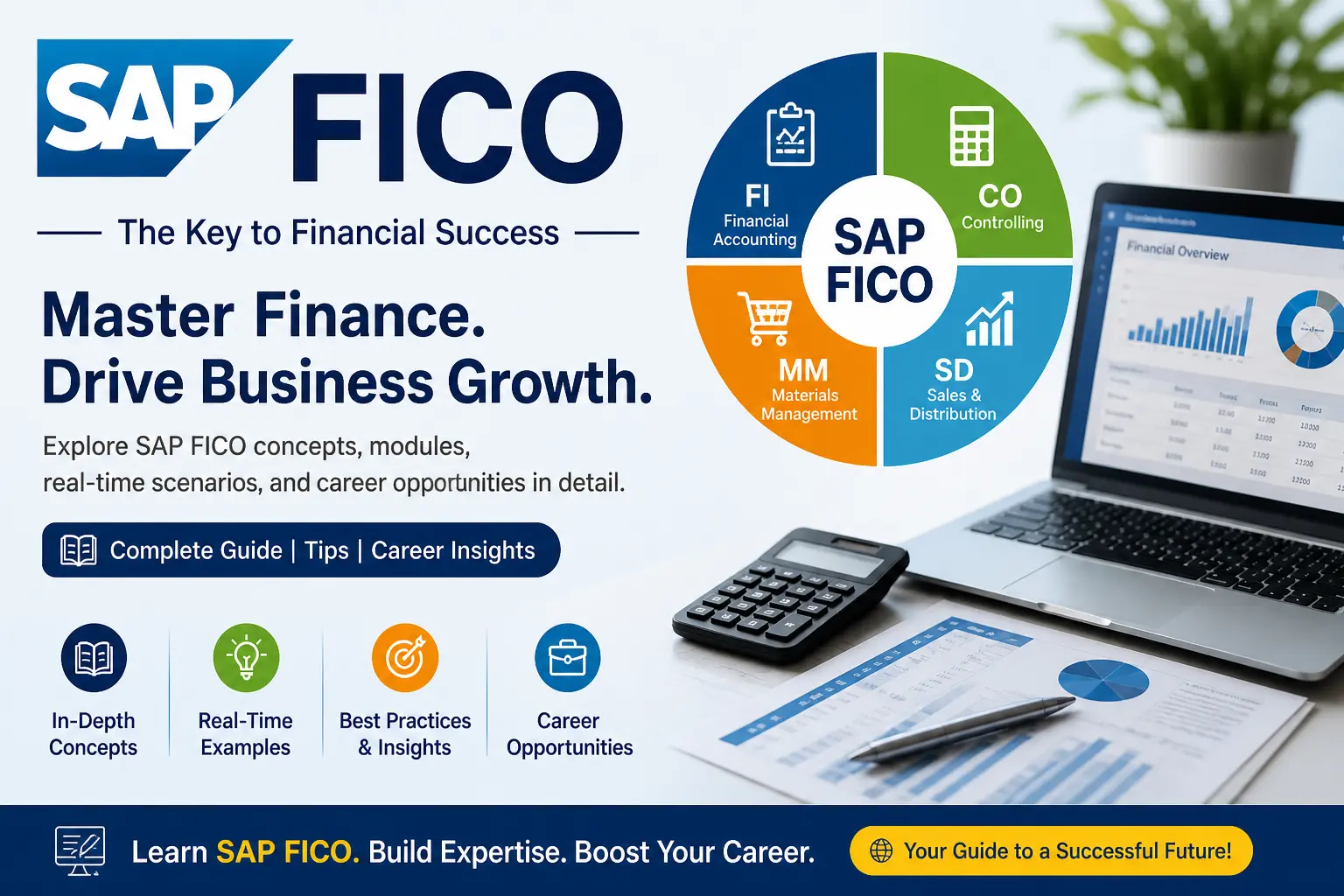
The 4 pillars of SAP are Financial Accounting (FI), Controlling (CO), Materials Management (MM), and Sales and Distribution (SD), which together handle finance, cost management, procurement, and sales operations in a business.
4. Is SAP FICO good for freshers?
Yes, SAP FICO offers strong career opportunities for freshers as companies look for candidates with ERP knowledge.
5. What are the main components of FI structure?
Company, Company Code, Business Area, Functional Area, and Fiscal Year Variant.
6. What is the difference between AP and AR?
Accounts Payable (AP) is the money a company owes to its suppliers, while Accounts Receivable (AR) is the money customers owe to the company
7. What is Asset Accounting?
Asset Accounting manages fixed assets, depreciation, and asset transactions.
admin