 admin
adminCrack Any Tech Interview with These Java Full Stack Developer Skills
The demand for skilled developers is growing rapidly, but competition is equally high. Many candidates struggle in interviews not because they lack knowledge, but because they focus on the wrong areas. To succeed, you need to master the right Java Full Stack Developer Skills that companies actually test. This blog will guide you through the essential skills, preparation strategy, and practical approach needed to crack any tech interview with confidence.
Why Java Full Stack Development is a Smart Career Choice
Java has been a backbone of enterprise applications for years. When combined with frontend technologies, it becomes a powerful full stack solution. Companies today prefer developers who can manage both client-side and server-side tasks. This not only reduces dependency on multiple teams but also speeds up development.
For job seekers, this means more opportunities, better salaries, and faster career growth. A strong foundation in Java full stack development makes you a versatile and valuable candidate in the job market.
Core Java: Your Strong Foundation
Every successful developer starts with strong basics. Core Java is the first area interviewers focus on. You should clearly understand object-oriented programming concepts such as classes, objects, inheritance, polymorphism, abstraction, and encapsulation.
Beyond theory, interviewers expect practical understanding. For example, you should be able to explain how collections work, how exception handling improves program stability, and how multithreading is used in real-world applications. If your fundamentals are solid, you can answer most technical questions with confidence.
Backend Development with Spring Boot
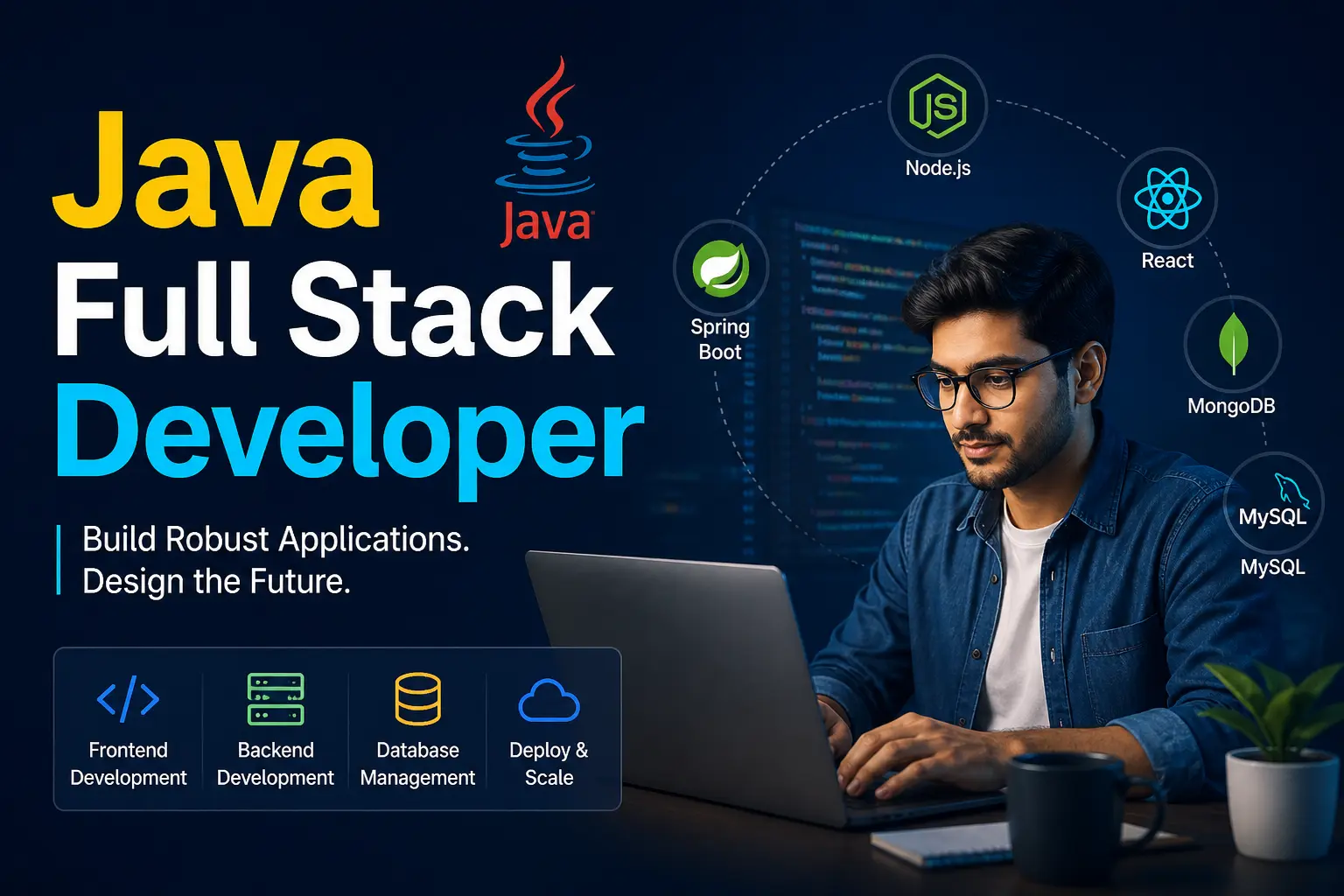
Spring Boot is one of the most important tools in a Java developer’s toolkit. It simplifies backend development and allows you to build scalable applications quickly. You should know how to create REST APIs, manage dependencies, and handle server-side logic.
Understanding how data flows between frontend and backend is crucial. You should also be familiar with concepts like dependency injection and basic microservices architecture. These are frequently discussed during interviews and can significantly boost your chances of selection.
Frontend Skills That Make You Stand Out
A full stack developer is expected to build user-friendly interfaces. Basic knowledge of HTML, CSS, and JavaScript is essential. In addition, learning a modern framework like React or Angular can give you an advantage.
You do not need to be a design expert, but you should understand how to structure web pages, manage components, and handle user interactions. Interviewers often test your ability to connect frontend with backend, so understanding this integration is important.
Database and Data Handling Skills
Data is at the core of every application. You should know how to work with relational databases like MySQL, including writing queries, performing joins, and managing tables. Understanding how to design a simple database schema is also useful.
Basic exposure to NoSQL databases like MongoDB can add value to your profile. Companies appreciate candidates who understand different types of data storage and when to use them.
Version Control and Collaboration
In real-world projects, developers work in teams. This is where version control tools like Git become essential. You should know how to manage code changes, create branches, and collaborate using platforms like GitHub.
Even if interviewers do not ask deep questions about Git, mentioning your experience with it shows that you are industry-ready and understand professional workflows
Problem Solving and Coding Practice
Technical interviews often include coding rounds to test your logical thinking. You should practice solving problems related to arrays, strings, and basic algorithms. The focus should be on understanding patterns rather than memorizing solutions.
Equally important is your ability to explain your approach. Interviewers look for clarity in thinking, not just correct answers.
Build Projects to Prove Your Skills
One of the best ways to stand out is by building real-world projects. A simple application like a task manager, online store, or blog platform can demonstrate your skills across frontend and backend.
When discussing projects in interviews, explain your role, the technologies used, and the challenges you faced. This shows practical experience and problem-solving ability, which recruiters highly value.
Smart Preparation Strategy
Preparation is not about learning everything at once. Focus on one skill at a time and revise regularly. Practice mock interviews to improve your confidence and communication.
Avoid common mistakes like ignoring fundamentals, skipping projects, or relying only on theoretical knowledge. Consistency and practical learning are the keys to success.
Conclusion
Cracking a tech interview requires more than just knowledge. It requires the right approach, consistent practice, and mastery of essential Java Full Stack Developer Skills. By focusing on strong fundamentals, building projects, and improving problem-solving abilities, you can confidently face interviews and secure a rewarding job in the tech industry.
Frequently asked question
1. What skills are required for Java full stack developer?
Java Full Stack Developer requires proficiency in Core Java, Spring Boot, frontend technologies (React/Angular), and database management (SQL/NoSQL) to build end-to-end applications. Key skills include developing RESTful APIs, utilizing Git for version control, containerization with Docker, and implementing security, such as JWT and OAuth.
2.Can I learn full stack in 1 month?
It is not possible to become a proficient, job-ready full stack developer in only 1 month. While you can learn basic syntax and build simple projects in 30 days with intensive effort, mastering frontend/backend integration, databases, and deployment generally takes 3–6 months or more
3.Will AI replace full-stack dev?
The simple and honest answer is no. AI is not a replacement for Java Full Stack Developers. Instead, it is becoming a support system that helps developers become more productive. Every real-time project has unique requirements.
4.What is a Java fullstack developer?
A Java Full Stack Developer is a versatile software professional capable of building an entire web application from start to finish. They are proficient in both front-end (client-side) and back-end (server-side) development, using the Java ecosystem as their core technology stack.
5.Is Java full stack difficult?
Java Full Stack is only difficult when learning is unplanned or rushed. However, when you follow a step-by-step learning path, practice regularly, and learn from experienced trainers, it becomes a highly rewarding and manageable skill.